2048 Strategy: The Corner Method and Other Tips That Actually Work
2048 is easy to learn and surprisingly hard to master. Many players slide tiles around at random and do well for a while, then watch the board fill up with small numbers that refuse to merge. This guide explains the corner method, the strategy most strong players rely on, plus a handful of habits that make a real difference to your scores.
How the game works
The board is a 4×4 grid. Each time you swipe or press an arrow key, every tile slides as far as it can in that direction. When two tiles with the same number touch during a move, they merge into one tile worth double. After every move, a new tile appears in a random empty cell, usually a 2 and occasionally a 4. You win by building a 2048 tile, and you lose when the board is full and no move can merge anything.
Two facts shape the whole strategy. First, new tiles appear in empty cells, so the fewer empty cells you have, the less control you have. Second, big tiles can only be built from smaller tiles that are next to them, so where your tiles sit matters as much as what they are. You can try every idea below in our free 2048 game.
The corner method
The core idea is simple: choose one corner and keep your largest tile there for the whole game. Most players pick a bottom corner, but any corner works as long as you stay consistent.
Say you choose the bottom-left corner. You then mainly use three directions: down, left and right. Pressing down and left pushes tiles towards your corner. Right is used when needed to shuffle the bottom row. The fourth direction, up, is the one you avoid, because it can pull your big tile out of the corner and let a small 2 or 4 drop into its place.
Why a corner?
A tile in a corner has only two neighbours instead of four, so it is hard for small tiles to get "behind" it. It also gives you a fixed anchor point. Every other tile can be arranged relative to that anchor, which turns a chaotic game into an organised one.
Build a chain along one row
Keeping the big tile in the corner is only half the method. The other half is to arrange your tiles in descending order along the bottom row. For example, you might aim for 256, 128, 64 and 32 from left to right. When a 32 appears next to the existing 32, they merge into 64, which then merges with the 64, and so on down the line into the corner. Players often call this a chain or a snake.
When the bottom row is full of large tiles, continue the chain into the row above, but in the opposite direction. So the second row runs from right to left, starting above the smallest tile of the bottom row. This zig-zag shape means the next tile you need to merge is always right next to the one it should join.
It will not always be perfect. What matters is keeping the general order, with big tiles along one edge and smaller tiles further away.
Keep your main row full
This is the tip many beginners miss. If your bottom row has an empty cell, pressing left or right can shift your corner tile out of place, and a random new tile can drop into the gap. Try to keep the bottom row completely filled so that left and right moves cannot disturb it.
When the row is full, left and right moves only affect the rows above, which gives you safe ways to rearrange tiles without touching your foundation.
What to do when things go wrong
Sooner or later you will be forced to press up. When that happens, do not panic:
- Press the opposite direction straight away. If you pressed up, press down on the next move. Often the big tile slides right back into its corner.
- Fill the gap quickly. If a small tile lands in your corner, work on merging it upwards as soon as possible so the corner becomes available again.
- Do not chase small merges. A merge of two 2s far from your chain is rarely worth breaking your structure.
More habits that help
- Slow down. There is no timer in 2048. Taking two seconds to think before each move is the single biggest improvement most people can make.
- Look one move ahead. Before pressing a key, picture where every tile will end up and where the empty cells will be.
- Keep empty cells. An open board gives new tiles room to appear harmlessly. If you have a choice between two moves, prefer the one that leaves more empty space.
- Merge towards the corner. When two equal tiles can merge in two different directions, choose the direction that moves the result closer to your chain.
- Accept restarts. Some games go wrong early. Treat each one as practice rather than frustration.
If you like the planning side of 2048, you may also enjoy the Sliding Puzzle, which rewards thinking several moves ahead in a similar way. For quick sessions, our list of games for a five-minute break has more ideas.
Key takeaways
- Pick one corner and keep your biggest tile there all game.
- Use mainly three directions and avoid the one that pulls tiles out of your corner.
- Arrange tiles in descending order along one row, then zig-zag into the next.
- Keep your main row full so side moves cannot disturb it.
- Slow down, plan one move ahead and keep as many empty cells as you can.
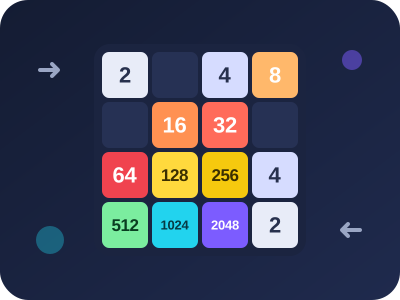
Slide numbered tiles, merge matching pairs and build your way up to the 2048 tile.
Play free