Four in a Row Tips: How to Build Threats and Win More Games
Four in a Row looks like a bigger version of Tic Tac Toe, but gravity changes everything. Because discs drop to the lowest free space in a column, you cannot simply place a piece wherever you like, and that opens up a world of traps, threats and forced moves. These tips will help you stop losing to simple tricks and start setting a few of your own.
How gravity changes the game
On the usual board of seven columns and six rows, players take turns dropping a disc into a column. The disc falls to the lowest empty space. The first player to line up four of their own discs horizontally, vertically or diagonally wins.
The key consequence of gravity is that a square can only be filled once the square below it is filled. So a winning square high up in a column is not immediately playable. It becomes a danger only when the column rises to meet it. Much of the strategy comes from managing who is forced to play underneath those important squares. You can try all of these ideas in our free Four in a Row game.
Control the centre
The single most useful habit is to play in the middle column early and often. A disc in the centre column can be part of more possible lines of four than a disc on the edge, because lines can extend in both directions. A disc in the outermost column can only join lines that stretch towards the middle.
Some practical guidelines:
- If you move first, the centre column is a strong opening.
- Prefer the three central columns in the early game.
- Edge columns are useful for blocking and for completing specific lines, but they rarely create threats on their own.
Understand threats
A threat is a line with three of your discs and one empty square that would complete four. Threats come in two kinds:
- Immediate threats, where the empty square is playable right now. Your opponent must block it at once.
- Future threats, where the empty square is floating above an empty space. Nobody can play there yet, but whoever is forced to fill the space below it hands the other player a chance to win.
Beginners notice only immediate threats. Stronger players pay close attention to future threats, because they quietly decide the endgame. A future threat of yours acts like a no-go zone for your opponent: they cannot play directly beneath it without losing.
Build double threats
Just as in Tic Tac Toe, the surest way to win is to create two threats at once. Your opponent can block only one per turn. Common ways to do this include:
- Stacked threats: two of your winning squares directly on top of each other in the same column. When your opponent blocks the lower one, you play the upper one and win.
- Horizontal open threes: three in a row on the bottom line with both ends empty and playable. The opponent can block only one end.
- Crossing lines: a single disc that completes a threat along a row and a diagonal at the same time.
Look for moves that do two jobs at once: block your opponent while adding to your own lines. Those moves are almost always better than a pure block.
Odd and even rows
This is the idea that separates casual players from experienced ones. Number the rows from the bottom, starting at 1. As the board fills up near the end of a game, columns get completed in a predictable order, and it turns out that the player who moves first naturally ends up being able to claim squares on odd-numbered rows, while the second player tends to claim squares on even-numbered rows.
The practical rule of thumb is:
- If you moved first, future threats on odd rows (1, 3, 5) are especially valuable.
- If you moved second, future threats on even rows (2, 4, 6) are especially valuable.
This is a simplification, and real positions can be more complicated, but it explains why some threats seem to "win by themselves" late in the game while others never come into play. When you have a choice between two threats, prefer the one on your row type.
Common mistakes to avoid
- Playing under your opponent's threat. Before every move, check whether the square you are filling gives your opponent a winning square directly above.
- Only blocking. Pure defence lets your opponent keep building. Try to answer threats with moves that also help you.
- Ignoring diagonals. Diagonal lines are the hardest to see and the source of many surprise losses. Scan them deliberately.
- Rushing. Take a moment to look at every column before dropping a disc. There are only seven choices, so checking all of them is quick.
If you are new to thinking in threats, start with our guide on how to never lose at Tic Tac Toe, which introduces forks on a smaller board. For another two-player strategy game with a very different feel, try Dots and Boxes.
Key takeaways
- Gravity means a square is only playable once the square below it is filled.
- Favour the centre column and the columns around it early in the game.
- Aim for double threats, such as two winning squares stacked in one column.
- As a rule of thumb, the first player benefits from odd-row threats and the second from even-row threats.
- Never play directly underneath your opponent's winning square.
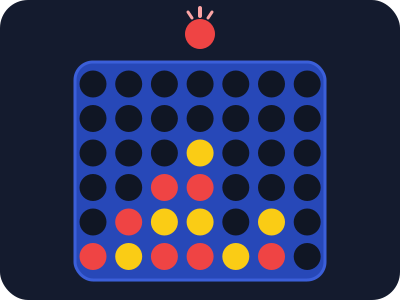
Drop coloured discs into a seven-column grid and be the first to line up four in any direction.
Play free