How to Never Lose at Tic Tac Toe
Tic Tac Toe is usually the first strategy game people learn, and for good reason: the board is tiny, the rules take seconds to explain, and yet there is real thinking involved. The good news is that you can learn to never lose. If both players make no mistakes, every game ends in a draw, and this guide shows you exactly how to make sure you are never on the losing side.
Why perfect play is always a draw
The board has only nine squares, which means the total number of possible games is small enough to check completely. People worked this out long ago, first by hand and later with computers, and the result is clear: if both players always choose a good move, neither can force a win. The game is what mathematicians call a solved game, and its value is a draw.
That is useful to know. It means you do not need to be clever to avoid defeat, only careful. Almost every loss comes from missing one of two things: an opponent's line of two that needs blocking, or a fork that sets up two threats at once.
Know your squares: centre, corners and edges
Not all squares are equal. It helps to think of them in three groups:
- The centre is part of four winning lines: one row, one column and both diagonals.
- Each corner is part of three lines: a row, a column and a diagonal.
- Each edge (the middle square on a side) is part of only two lines.
More lines means more chances to create threats, so the centre is the strongest square, corners come next, and edges are the weakest. This simple ranking guides most of your decisions.
Forks: the only way to really win
A fork is a move that creates two lines of two at the same time, each needing only one more mark to win. Your opponent can block only one per turn, so you complete the other and win. Against a careful player, forks are the only way a game is ever won.
A classic example: you hold the top-left corner and your opponent holds the centre. Later you take the bottom-right corner, and the opponent carelessly answers in the top-right corner. You then take the bottom-left corner, which threatens the bottom row and the left column at once. There is no way to block both.
So the key defensive rule is this: before every move, ask yourself whether your opponent could create a fork next turn, and if so, take a square that stops it.
Playing first (as X)
When you move first, you have two good openings.
Start in a corner
A corner opening gives the second player the most chances to go wrong. If they reply anywhere except the centre, you can force a win with correct play. If they take the centre, the game is likely to be drawn, but you still keep the pressure on.
Start in the centre
The centre is the safest opening and makes it easy to create threats. If your opponent answers on an edge, you can usually build a fork. If they answer in a corner, expect a draw unless they slip up later.
Opening on an edge is not a losing move, but it gives your opponent the easiest time, so most players avoid it.
Playing second (as O)
Defending is where most beginners lose, so memorise these replies:
- If X starts in a corner, take the centre. Any other reply lets X force a win.
- If X starts in the centre, take a corner. Taking an edge allows X to set up a fork.
- If X starts on an edge, the centre is a safe reply.
There is one famous trap to know. X takes a corner, you take the centre, and X takes the opposite corner. Now you must play on an edge, not in a corner. If you take a corner, X takes the last free corner and creates a fork. Playing an edge forces X to block you, and the game heads to a draw.
A simple priority list for every move
If you follow this checklist in order, you will never lose a game of Tic Tac Toe:
- Win: if you have two in a line and the third square is free, take it.
- Block: if your opponent has two in a line, block the third square.
- Fork: create two threats at once if you can.
- Block a fork: if your opponent could fork next turn, stop it, ideally by making a threat of your own that forces them to respond.
- Centre: take it if it is free.
- Opposite corner: if your opponent holds a corner, take the one opposite.
- Empty corner: otherwise take any corner.
- Empty edge: take an edge only if nothing else is available.
Try it now in our Tic Tac Toe game. Once you find it easy, the same ideas of threats and forks carry over to bigger games such as Four in a Row, which is covered in our guide to building threats in Four in a Row.
Key takeaways
- With perfect play from both sides, Tic Tac Toe always ends in a draw.
- The centre is the strongest square, then corners, then edges.
- Forks, two threats at once, are the only way to beat a careful player.
- As O, answer a corner opening with the centre and a centre opening with a corner.
- Check the priority list every move: win, block, fork, block a fork, then centre, corners and edges.
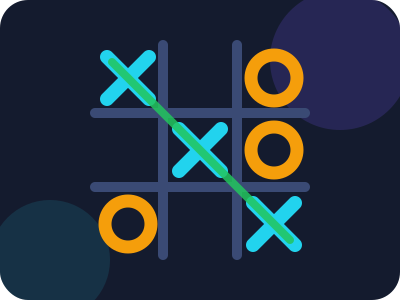
The classic three-in-a-row duel, with a computer opponent that ranges from friendly to flawless.
Play free