How to Solve Sudoku: A Beginner's Step-by-Step Guide
Sudoku looks like a maths puzzle, but you never add or multiply anything. It is a logic puzzle that uses the digits 1 to 9 as symbols, and every well-made puzzle can be solved by careful reasoning alone, without guessing. This guide walks you through the core techniques in the order most people learn them, so you can go from staring at an empty grid to finishing puzzles with confidence.
The rules in one minute
A standard Sudoku grid has 81 cells arranged in nine rows, nine columns and nine 3×3 boxes. Some cells already contain digits, called givens. Your job is to fill every empty cell so that:
- each row contains the digits 1 to 9 exactly once,
- each column contains the digits 1 to 9 exactly once, and
- each 3×3 box contains the digits 1 to 9 exactly once.
That is all. A properly designed puzzle has exactly one solution, which is why logic is enough. If you ever find yourself guessing, it usually means there is a deduction you have not spotted yet. You can practise everything below on our free Sudoku game, which lets you start on easier grids and move up as you improve.
Step 1: Scanning for easy placements
Scanning is the fastest technique and the one you will use most. Pick a digit, say 5, and look at where the 5s already are. Every 5 in the grid "blocks" its whole row and its whole column for other 5s. Now look at one box that does not yet have a 5. If the rows and columns crossing that box block every empty cell except one, then the 5 must go in that remaining cell.
A good habit is to scan digit by digit, starting with the digit that appears most often in the givens. Common digits give you more blocking lines, so they tend to produce quick placements. Work through 1 to 9, then go around again, because each new digit you place can unlock others.
Cross-hatching
The scanning method above is often called cross-hatching, because you imagine lines running across the grid from each existing digit. After a few puzzles, your eyes will start to do it automatically.
Step 2: Pencil marks (candidates)
Scanning alone solves many easy puzzles, but at some point you will get stuck. That is when pencil marks help. For each empty cell, write the small digits that could still legally go there, given what is already in its row, column and box. These possible digits are called candidates.
Filling in every candidate for the whole grid takes a few minutes, but it turns a puzzle of "where could this go?" into a puzzle of "which options can I cross out?". Two tips make pencil marks much easier to manage:
- Update them immediately. When you place a digit, remove it from the candidates of every cell in the same row, column and box.
- Be accurate rather than fast. One missing candidate can lead you to a wrong placement that ruins the grid many moves later.
Step 3: Naked singles and hidden singles
With candidates in place, look for two simple patterns.
Naked single
A naked single is a cell that has only one candidate left. If a cell's row, column and box already contain eight different digits between them, the ninth digit is the only one that fits, so you can write it in.
Hidden single
A hidden single is a digit that has only one possible home in a row, column or box, even though that cell may have several candidates. For example, a cell might show candidates 2, 6 and 8, but if no other cell in its box can hold a 6, then the 6 must go in that cell. The other candidates are "hiding" the answer, which is where the name comes from.
Between them, naked and hidden singles solve most easy and medium puzzles. Always check for them before trying anything fancier.
A small worked example
Imagine the top-left box of a puzzle. It already contains the digits 1, 3, 4, 7 and 9, leaving four empty cells: two in the top row of the box and two in the bottom row. The missing digits for this box are therefore 2, 5, 6 and 8.
Now look outside the box. The top row of the whole grid already has a 2 and a 6 further to the right. That means neither empty cell in the box's top row can be 2 or 6, so those two cells can only be 5 or 8. Next, you notice that the first column contains an 8 lower down in the grid. The top-left empty cell sits in that column, so it cannot be 8. Its only remaining candidate is 5, a naked single, so you write 5 there.
The other top-row cell must then be 8, because 5 is used and 2 and 6 were already ruled out. The two bottom cells now share the remaining digits 2 and 6. Both of them sit in the same row, so the row cannot tell them apart; look at the columns instead. Suppose the second column has a 2 further down the grid. Then the bottom cell in the second column cannot be 2, so it must be 6, and the last cell takes the 2. Four cells solved with nothing more than careful checking of rows and columns.
Step 4: Naked pairs and hidden pairs
When singles run out, pairs are the next tool to learn.
A naked pair is two cells in the same row, column or box that both have exactly the same two candidates, for example 4 and 7. Those two digits must go in those two cells, one each, even if you do not yet know which way round. That means you can remove 4 and 7 from the candidates of every other cell in that same row, column or box. Often this removal creates a new single somewhere else.
A hidden pair works the other way. If two digits can only appear in the same two cells within a unit, those cells must contain those two digits. You can then delete every other candidate from those two cells, which tidies up the grid and frequently reveals new placements.
The same ideas extend to triples and quads, but pairs are by far the most common and the most useful for beginners.
Whatever technique you use, never guess: if you feel stuck, re-check your candidates, because most "impossible" positions come from one small slip. If you enjoy this style of deduction, the same "what must be true here?" thinking powers Minesweeper, and our guide to Minesweeper patterns shows how.
Key takeaways
- Every row, column and 3×3 box must contain 1 to 9 exactly once, and good puzzles never require guessing.
- Start by scanning one digit at a time across the grid.
- Use pencil marks when scanning stops working, and keep them updated.
- Look for naked singles and hidden singles first, then naked and hidden pairs.
- When stuck, check your candidates for mistakes before assuming the puzzle is too hard.
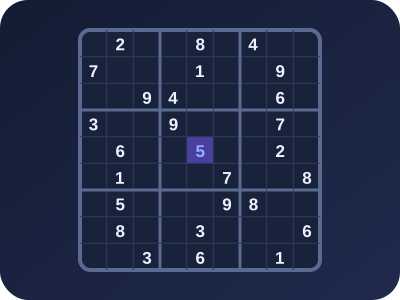
Fill the 9x9 grid so every row, column and box holds the digits 1 to 9 exactly once.
Play free