Minesweeper Patterns Explained: 1-1, 1-2, 1-2-1 and More
Minesweeper is often dismissed as a guessing game, but most of the board can be solved with pure logic. Experienced players rarely count every number from scratch; instead they recognise small patterns that always mean the same thing. Learn the handful of patterns in this guide and you will clear boards faster, with far fewer unlucky clicks.
The basics every pattern builds on
Each number tells you how many mines touch that cell, counting all eight neighbours, including diagonals. Two simple rules come straight from that:
- If a number already touches that many flagged mines, every other hidden neighbour is safe.
- If a number has exactly as many hidden neighbours as its value, all of those hidden neighbours are mines.
For example, a 1 in the corner of an opened area that touches only one hidden cell must have its mine in that cell. The patterns below are just shortcuts for combining these rules across two or more neighbouring numbers.
For every pattern, picture a straight line of revealed numbers with a row of hidden cells running along one side of it, and nothing else hidden around those numbers. This "wall" of numbers facing a row of unknown cells is the most common situation on a real board. You can practise spotting these shapes in our free Minesweeper game.
The 1-1 pattern
Suppose two 1s sit side by side along the edge of the hidden area, and the first 1 is next to a wall, meaning the board edge or an already opened cell. Call the hidden cells facing them A, B and C, where A and B touch the first 1, and A, B and C all touch the second 1.
The first 1 has only A and B as hidden neighbours, so its single mine is in A or B. The second 1 also touches A and B, so that same mine already satisfies it. Therefore C must be safe. In short: when a 1-1 starts from a wall, the third cell along is safe to click.
This pattern repeats. After C is opened and shows its number, you often find another pattern waiting right behind it.
The 1-2 pattern
Now picture a 1 next to a 2 along the edge. The 1 touches three hidden cells: call them A, B and C. The 2 touches B, C and a further cell, D.
The 1 says there is at most one mine among A, B and C, so there is at most one mine among B and C. But the 2 needs two mines among B, C and D. Since B and C can supply only one, D must be a mine. Put simply: in a 1-2, the cell beyond the 2, on the side away from the 1, is a mine.
Once you flag D, the 2 needs only one more mine among B and C, which often combines with other numbers to solve the rest of the row.
The 1-2-1 pattern
This is one of the most satisfying patterns because it solves five cells at once. Three numbers, 1, 2 and 1, sit in a row with five hidden cells facing them. The table below shows the answer, with the numbers on top and the hidden cells underneath.
| Revealed | (edge) | 1 | 2 | 1 | (edge) |
|---|---|---|---|---|---|
| Hidden | Safe | Mine | Safe | Mine | Safe |
Why does it work? The 2 needs two mines among the three cells in front of it. If the middle cell were a mine, the left 1 would already be satisfied, so the cell under the left 1 could not be a mine, and the same would be true on the right. That would give the 2 only one mine, which is impossible. So the middle cell is safe, and the 2's two mines must be the cells directly under each 1. Those mines satisfy both 1s, which makes the two outer cells safe as well.
The quick way to remember it: in a 1-2-1, the mines sit under the 1s.
The 1-2-2-1 pattern
A close cousin of the last pattern is 1-2-2-1, four numbers in a row facing six hidden cells. The answer is that the mines sit under the two 2s, and every other cell in that row of six is safe.
You can check it with the same kind of reasoning. Each 1 at the ends can have only one mine near it. The two 2s share two of the cells in front of them, and the only way to give both 2s their two mines without overloading either 1 is to place the mines directly under the 2s. If you learn 1-2-1 first, this one is easy to remember because the mines again line up under the middle numbers.
Using patterns in real games
Real boards are messier than neat examples, so a few habits help:
- Reduce the numbers first. If a 3 already touches one flagged mine, treat it as a 2 for pattern purposes. A 2 with one flag becomes a 1. Many hidden patterns appear only after this step.
- Check that the row is clean. Patterns assume the numbers have no other hidden neighbours. If there is an extra hidden cell behind a number, the pattern may not apply.
- Work along edges. Borders and corners limit the number of neighbours, which makes patterns much more common there.
- Count mines late in the game. Near the end, the total mine counter can settle situations that local patterns cannot.
- Guess only when forced. Sometimes the board truly offers no safe move. When that happens, pick the cell with the best odds and move on.
If you enjoy this kind of deduction, the same way of thinking helps in Sudoku. Our beginner's guide to Sudoku explains the logic step by step.
Key takeaways
- Every number counts mines in all eight surrounding cells, including diagonals.
- 1-1 starting from a wall: the third cell along is safe.
- 1-2: the cell beyond the 2, away from the 1, is a mine.
- 1-2-1: mines under the 1s; 1-2-2-1: mines under the 2s.
- Subtract flagged mines from numbers first, and patterns will appear far more often.
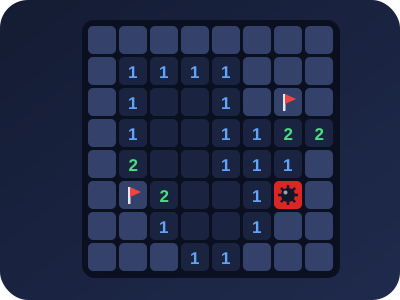
Clear the minefield using number clues, flag the hidden mines and beat your best time.
Play free