Reversi Strategy Basics: Corners, Edges and Mobility
Reversi has a reputation for being easy to learn and hard to master, and it deserves it. The rules fit on a postcard, but the natural instinct of most beginners, flipping as many discs as possible, turns out to be one of the worst strategies. This guide explains the ideas that stronger players use instead: corners, careful edge play and mobility.
A quick rules recap
Reversi is played on an 8×8 board with discs that are dark on one side and light on the other. The game starts with four discs in the centre. On your turn you place a disc so that one or more straight lines of your opponent's discs are trapped between your new disc and another of yours. Those trapped discs flip to your colour. Lines can run horizontally, vertically or diagonally. If you have no legal move, you pass. When neither player can move, the player with more discs wins.
Because discs keep flipping back and forth, the count in the middle of the game means very little. What matters is who will be in control at the end. You can try everything here in our free Reversi game.
Why corners are so valuable
A disc in a corner can never be flipped. There is no way to place discs on both sides of it, so once you own a corner, it is yours for the rest of the game. Even better, a corner acts as an anchor. Discs next to it along the edges can become permanent too, because they can no longer be trapped from the corner side. These unflippable discs are called stable discs, and a player with many stable discs is very hard to beat.
That is why so much Reversi strategy is about corners: getting them for yourself and, just as importantly, not giving them away.
The squares next to corners
The fastest way to lose a corner is to play next to it before it is taken. Players often use two names for these risky squares:
- X-squares are the squares diagonally next to each corner. Playing there early is usually a serious mistake, because it often lets your opponent take the corner by flipping along the diagonal.
- C-squares are the squares directly next to a corner along an edge. They are less dangerous than X-squares but can still hand over a corner if the edge position is wrong.
A simple rule for beginners: avoid X-squares unless the nearby corner is already taken, and be cautious with C-squares. Once a corner is occupied, the squares around it become much safer to use.
Playing the edges
Edges are attractive because discs there can only be flipped along the edge itself, not from outside the board. That makes edge discs harder to attack than central ones. But edges have a catch: a badly shaped edge can give your opponent a route into a corner.
Some general guidance:
- Edge discs are good when they connect to a corner you own or cannot easily be attacked.
- Be careful about leaving a single gap on an edge that your opponent can fill to flip your discs.
- Do not rush to fill edges early just because they look safe. Often it is better to wait until your opponent is forced to move there first.
Mobility: the hidden key to winning
Mobility means the number of legal moves you have. It is probably the most important idea in the middle game. If you have many possible moves and your opponent has very few, they will soon be forced into bad moves, such as an X-square that gives you a corner.
This is why flipping lots of discs early is often a mistake. The more of your colour there is on the board, the more targets your opponent has and the fewer moves you tend to have. Strong players frequently hold fewer discs in the middle of the game on purpose, then take over at the end.
Two practical ideas help with mobility:
- Prefer quiet moves. A move that flips only one or two discs, especially discs in the interior, often keeps your options open and limits your opponent's.
- Avoid frontier discs. A frontier disc is one next to an empty square. Frontier discs give your opponent places to move. Try to keep your discs inside, surrounded by other discs, and leave the frontier to your opponent.
A word on the endgame
As the board fills up, counting becomes more important. Look at how many empty squares remain in each region. If a region has an odd number of empty squares, the player who moves last there often gains an advantage, an idea known as parity. You do not need to calculate this perfectly as a beginner. Simply trying to get the last move in each small region is a good habit.
If you like strategy games where each move sets up the next, you might also enjoy Four in a Row. Our article on building threats in Four in a Row explains a similar way of thinking ahead.
Key takeaways
- Corners can never be flipped, so they are the most valuable squares on the board.
- Avoid X-squares, diagonally next to empty corners, and be careful with C-squares.
- Mobility, having more legal moves than your opponent, matters more than disc count in the middle game.
- Make quiet moves and avoid creating frontier discs.
- Near the end, try to get the last move in each region of the board.
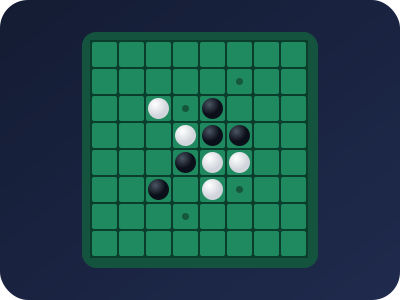
Outflank the computer's discs, flip them to your colour and own the board.
Play free