Can Word Games Build Your Vocabulary? Tips for Word Search and Word Guess
Word games are a popular way to pass the time, and many players hope they are learning something along the way. For people improving their English as a second or third language, that hope is especially strong. So can word games really build your vocabulary? The honest answer is that they can help, but mostly when you play them with a bit of intention. This article explains why and gives practical tips for two of our games.
How vocabulary actually grows
Most people learn new words through repeated exposure in context. You meet a word while reading, listening or talking, guess its meaning from the situation, meet it again later, and gradually it becomes part of your own vocabulary. Using a word yourself, in speech or writing, helps it stick even more.
That suggests an important point about games. A game that shows you words you already know can make you faster at recognising and spelling them, which is useful. But on its own, it will not necessarily teach you new words and their meanings. To grow your vocabulary, you need to meet unfamiliar words and find out what they mean.
What word games do well
Even with those limits, word games have real strengths:
- Spelling practice. Searching for or guessing words makes you pay close attention to the exact order of letters.
- Letter patterns. Over time, you get a feel for which letter combinations are common in English, such as "th", "ing" or "tion", and which are rare.
- Quick recall. Games encourage you to bring words to mind quickly, which can help fluency.
- Motivation. A game is often more fun than a word list, so you may practise more often.
For learners of English, there is another quiet benefit. English spelling is famously irregular, and words are often not written the way they sound. Seeing words like "through", "knight" or "island" again and again in a game grid helps the correct spelling feel familiar, which makes reading and writing them easier later.
These benefits are modest but worthwhile. Word games work best as a fun supplement to reading and conversation, not as a replacement for them.
Getting more from Word Search
In Word Search, you find hidden words in a grid of letters. The words can run in several directions. Here is how to make it a little more educational:
- Read the list first. Before searching, read every word on the list and check you know its meaning. If one is unfamiliar, look it up.
- Say the word as you search. Saying it in your head, or quietly aloud, connects the spelling with the sound.
- Look for unusual letters. Start with letters like Q, X, Z or J, which appear less often and are easier to spot.
- Write down new words. Keep a small notebook or a note on your phone. Add any new word with a short meaning and an example sentence.
Getting more from Word Guess
Word Guess asks you to find a hidden word using feedback from each attempt. It rewards both vocabulary and logical thinking.
- Start with common letters. A first guess containing frequently used letters, including a few vowels, tends to reveal the most information.
- Use every clue. Before each guess, remind yourself which letters are confirmed, which are in the word but in the wrong place, and which are ruled out.
- Think about patterns. Common endings and letter pairs can help you narrow down the options.
- Learn from the answer. If the answer is a word you did not know, look up its meaning and try to use it in a sentence that day.
The logical side of Word Guess is similar to solving puzzles like Sudoku: you gather clues and eliminate possibilities step by step.
Going beyond games
If building vocabulary is your real goal, combine games with a few habits that research on language learning generally supports:
- Read regularly. Articles, stories and books on topics you enjoy expose you to many words in context.
- Review words over time. Looking back at your list of new words after a day, a few days and a week helps you remember them for longer.
- Use new words. Try each new word in conversation or a message. Active use helps memory.
- Learn word families. When you learn "decide", also notice "decision" and "decisive". One new word can lead to several.
Memory techniques can help too. Our guide on memory games and recall tips explains chunking and visualisation, which work well for vocabulary.
Key takeaways
- Vocabulary grows mainly through repeated exposure to words in context and active use.
- Word games are great for spelling, letter patterns and quick recall, but they need a little intention to teach new words.
- In Word Search, check the meaning of every word on the list and note new ones.
- In Word Guess, use every clue and look up any answer you did not know.
- Combine games with reading, review and using new words in real conversation.
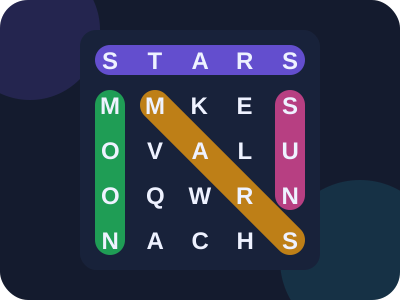
Hunt for hidden words in a grid of letters, with themed puzzles and a timer to beat.
Play free