Are Puzzle Games Good for Your Brain? What We Actually Know
You have probably seen headlines claiming that a daily puzzle will keep your mind sharp or even protect your brain as you age. It is a comforting idea, and puzzles are certainly enjoyable, but the real picture is more complicated than the headlines suggest. This article takes an honest look at what is reasonably well understood, what is still uncertain, and how to think about puzzles without overclaiming.
The big question: does practice transfer?
There is no doubt that you get better at a puzzle by playing it. If you solve Sudoku every day for a month, you will become faster and more accurate at Sudoku. That kind of improvement is real and easy to observe.
The harder question is whether those skills transfer to other tasks. Does getting better at Sudoku make you better at remembering names, managing money or concentrating at work? Researchers call this "far transfer", and it is where the evidence becomes mixed. Many studies have looked at brain-training games and similar activities. Some have reported small benefits, others have found little or no effect beyond the trained task, and scientists continue to debate how to interpret the results. Overall, there is no strong agreement that playing a particular game will make you broadly smarter.
So the fair summary is this: puzzles clearly train the specific skills they use, but claims that they boost general intelligence or prevent illness go beyond what the evidence clearly supports.
What puzzles do exercise
Even without grand claims, it is easy to see that different puzzles ask your brain to do different things:
- Logic puzzles such as Sudoku and Minesweeper ask you to hold several facts in mind and draw careful conclusions.
- Memory games such as Memory Match ask you to remember locations and sequences for a short time.
- Word games ask you to search for patterns in letters and recall words you know.
- Speed games such as Quick Math ask you to respond quickly and accurately under a little time pressure.
Practising any of these can make you more comfortable with that kind of thinking. Whether it spreads further is the uncertain part, but the activity itself is still mentally engaging.
More realistic benefits
If puzzles are not a magic brain pill, why play them? There are plenty of modest, sensible reasons that do not depend on big scientific claims:
- Enjoyment. Having fun is a perfectly good reason to do something in your free time.
- A sense of progress. Solving a hard puzzle or beating your best score is satisfying, and watching yourself improve can be motivating.
- A mental change of scene. A short puzzle can be a pleasant break from work, study or scrolling through news.
- Focus. Many people find that a puzzle holds their attention in a calm way, which can feel relaxing.
- Social connection. Two-player games or comparing scores with friends and family can be a nice way to spend time together.
These benefits are personal and vary from person to person, but they do not need a laboratory to be worthwhile.
Be careful with bold claims
Because "brain health" is a popular topic, you will see products and articles that promise a lot. A few warning signs are worth knowing:
- Claims that a game can prevent, treat or cure a medical condition.
- Specific percentages of improvement with no clear source.
- Promises that a few minutes a day will make you "smarter" in every area of life.
We do not make those claims about our games, and you should be wary when others do. If you have real concerns about your memory, concentration or mental health, the right step is to talk to a doctor or another qualified professional rather than relying on games.
Getting the most out of puzzles
If you enjoy puzzles and want to make them a positive part of your routine, a few simple habits help:
- Mix things up. Trying different kinds of puzzles keeps them interesting and gives you a wider range of challenges.
- Keep it challenging but not frustrating. A puzzle that is slightly harder than comfortable tends to be the most engaging.
- Balance screen time. Puzzles are one part of a full life that also includes sleep, movement, time outdoors and time with other people. Our guide to healthy gaming habits has practical tips on breaks and posture.
- Learn the techniques. Understanding strategy, for example through our beginner's guide to Sudoku, often makes a game more rewarding than simply repeating it.
Key takeaways
- Playing a puzzle regularly makes you better at that puzzle; that part is clear.
- Evidence that puzzle skills transfer to general intelligence or everyday memory is mixed.
- Enjoyment, focus, a sense of progress and relaxation are good reasons to play on their own.
- Be sceptical of games or articles that promise medical or dramatic mental benefits.
- If you have health concerns, speak to a qualified professional.
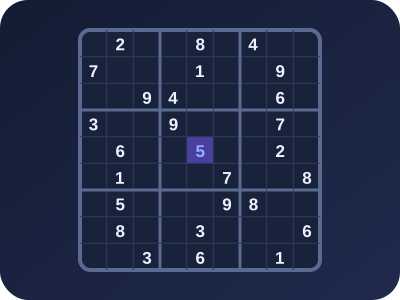
Fill the 9x9 grid so every row, column and box holds the digits 1 to 9 exactly once.
Play free